Request: MC4 Connectors for Solar HV Battery Charging

brp

Traveler Harvester
Member
First Name
Brian
Joined
Oct 3, 2025
Threads
1
Messages
7
Reaction score
3
Location
USA
Vehicles
Tesla Model Y, Chrysler Pacifica PHEV, Ford F250
The optional ability to charge the HV battery with solar would be great.

Some EV/PHEV owners do this now, but it requires a solar generator and other costs, complexities, and inefficiencies.

I know the realities of the range added, array size, etc.

 

ohseedee

Member
Joined
Jan 7, 2025
Threads
0
Messages
7
Reaction score
23
Location
California
Vehicles
R1T
I see that you’re acknowledging the low range gains, so I won’t argue the lack of ROI here. But the idea that they can just add some cheap MC4 connectors misses the sheer complexity of how solar-to-EV charging would actually work. Building this into a standard production vehicle is basically an engineering non-starter.

The real issue is the massive voltage gap. You’re talking about trying to shove maybe 20V–40V from regular solar panels into a 400V or 800V battery system. To bridge that, Scout would have to build in a heavy, expensive, industrial-grade MPPT and DC-DC boost converter. We aren't talking about small, off-the-shelf equipment; these are bulky pieces of power electronics that add weight, create heat, and cost thousands—all to accommodate a trickle of energy that might barely cover the car's standby 'vampire' drain.

Then there’s the safety and liability. No manufacturer is going to give a 'DIY backdoor' to a high-voltage battery. These systems require a precise digital handshake between the charger and the BMS before a single electron moves. Without that, you’re one bad connection away from a very bad day.

There’s a reason people use external gear like solar generators or portable power stations: it’s the only way that’s actually safe and efficient. Let the external station handle the messy voltage conversion and safety protocols, then just plug it into the car’s existing charge port. Expecting a brand to bake that level of niche complexity and risk into the car's chassis is just asking for a vehicle that’s more expensive and less reliable for everyone.
 
OP
OP

brp

Traveler Harvester
Member
First Name
Brian
Joined
Oct 3, 2025
Threads
1
Messages
7
Reaction score
3
Location
USA
Vehicles
Tesla Model Y, Chrysler Pacifica PHEV, Ford F250
The MC4 connectors could go to an inverter and AC charge the battery. No?
 

joewilk45

Traveler Harvester
Well-Known Member
First Name
joseph
Joined
Oct 28, 2024
Threads
1
Messages
612
Reaction score
513
Location
Florida
Vehicles
2023 Volvo xc90 recharge plug in / 2015 Lexus nxt200
This is some cool solutions to range anxiety and long distance trips these swap stations could be placed in out of way areas self powered by solar pretty cool.


ohseedee

Member
Joined
Jan 7, 2025
Threads
0
Messages
7
Reaction score
23
Location
California
Vehicles
R1T
The MC4 connectors could go to an inverter and AC charge the battery. No?
No, as you are still missing key equipment needed to make this work.

To make this work, you’d essentially need a complete portable power station—like an EcoFlow—directly into the Scout's chassis. You would need an MPPT, an inverter, and crucially, a secondary lithium buffer battery.

Because solar output fluctuates every time a cloud passes or a shadow hits a panel, you can't feed that 'jittery' power directly into the high-voltage battery. You need that intermediate buffer battery to stabilize the energy flow before an inverter can even start converting it to AC.

Between the buffer battery, the MPPT controller, and the inverter, you’re adding significant dead weight that hurts your daily range and payload capacity. You’d probably need somewhere in the range of half the front truck in terms of space to make this work. Expecting a brand to bake an entire secondary power ecosystem into the car just to bypass their own perfectly good AC charger is a massive technical penalty for a very niche gain.

If you really want to charge your HV via solar, an external system is the only option.
 

Timmdodge60

Terra EV
New Member
First Name
Tim
Joined
Oct 26, 2024
Threads
0
Messages
4
Reaction score
3
Location
Orlando
Vehicles
Lexus RX350
I see that you’re acknowledging the low range gains, so I won’t argue the lack of ROI here. But the idea that they can just add some cheap MC4 connectors misses the sheer complexity of how solar-to-EV charging would actually work. Building this into a standard production vehicle is basically an engineering non-starter.

The real issue is the massive voltage gap. You’re talking about trying to shove maybe 20V–40V from regular solar panels into a 400V or 800V battery system. To bridge that, Scout would have to build in a heavy, expensive, industrial-grade MPPT and DC-DC boost converter. We aren't talking about small, off-the-shelf equipment; these are bulky pieces of power electronics that add weight, create heat, and cost thousands—all to accommodate a trickle of energy that might barely cover the car's standby 'vampire' drain.

Then there’s the safety and liability. No manufacturer is going to give a 'DIY backdoor' to a high-voltage battery. These systems require a precise digital handshake between the charger and the BMS before a single electron moves. Without that, you’re one bad connection away from a very bad day.

There’s a reason people use external gear like solar generators or portable power stations: it’s the only way that’s actually safe and efficient. Let the external station handle the messy voltage conversion and safety protocols, then just plug it into the car’s existing charge port. Expecting a brand to bake that level of niche complexity and risk into the car's chassis is just asking for a vehicle that’s more expensive and less reliable for everyone.
I would use the method of charging a portable power station (solar generator) with the solar panels and then plug the power station into the vehicle. I'm all for minimizing cost built into the vehicle.
 

ohseedee

Member
Joined
Jan 7, 2025
Threads
0
Messages
7
Reaction score
23
Location
California
Vehicles
R1T
I would use the method of charging a portable power station (solar generator) with the solar panels and then plug the power station into the vehicle. I'm all for minimizing cost built into the vehicle.
Yeah, it’s the only way. However, even a portable power station isn’t really practical. I’ve tried it and abandoned the idea. you’re better off using solar to power non-vehicle loads like device charging, camp refrigerator, etc... The only real practical use of solar with a car is keeping the 12V system charged for long periods of non-use to prevent vampire drain.
 

joewilk45

Traveler Harvester
Well-Known Member
First Name
joseph
Joined
Oct 28, 2024
Threads
1
Messages
612
Reaction score
513
Location
Florida
Vehicles
2023 Volvo xc90 recharge plug in / 2015 Lexus nxt200
I came upon this about battery swapping seems like a great idea for long travel and battery longevity


SchnauzerDad

Traveler EV
Active Member
Joined
Oct 19, 2025
Threads
2
Messages
30
Reaction score
19
Location
Portland OR
Vehicles
2025 Defender, 2025 FPace, 2023 FiskerOcean
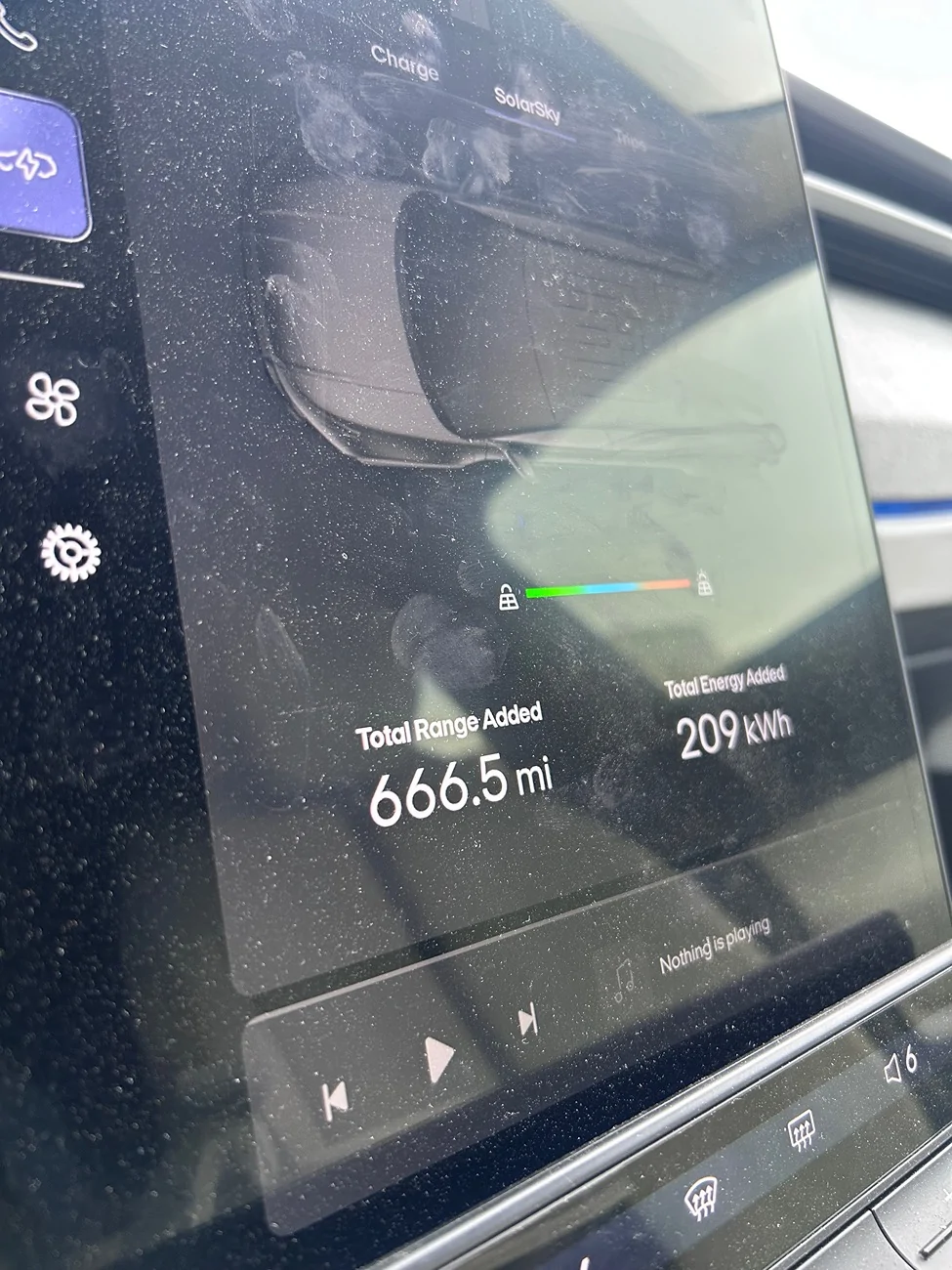
Just to give you an idea of how little electron fill-up you get with the sun, here a pic I took in my Fisker after 2-1/2 years of driving with its solar panel roof. Admittedly the first 1-1/2 years it got parked in my nice shady garage when I was home, but after I got my Defender it has sat outside since last January.

The satan-ish amount of sun-fuel I got probably hasn’t even covered the vampire drain it’s had.

Henrik Fisker claimed it would get between 1500 and 2000 miles a year 😂😂😂 of solar panel power. Snake oil salesman of the decade. The cost of that panel into the car was huge. But HF wanted it because he could keep lying how sustainable it was and was saving the planet. It is cool looking but a parts decision that would make any bean-counter cringe.
IMG_3381.webp
 
Top