How to plan for home charger installation

PMurphy

Traveler EV
Well-Known Member
First Name
Patrick
Joined
Jan 25, 2025
Threads
4
Messages
86
Reaction score
123
Location
Wisconsin
Vehicles
Jeep Gladiator diesel, Ram TRX/1500 diesel
I have started to assess where and how I will install a home charger. Pretty sure my current breaker box is close to maxed out. Considering a dedicated circuit. How many amps should I plan for? Any unique workarounds others have used?

 

bababooey

Terra EV
Member
First Name
Gary
Joined
Dec 16, 2025
Threads
0
Messages
19
Reaction score
12
Location
Near the ocean
Vehicles
Lightning, Rivian
If Scoutt does the BEV right, you need to plan for 100 amps for a 80 amp charging experience. They will cheap out and not do this and only support 48 amp so you should plan for:
1. Real commitment to EV charging and plan for 100 amp circuit
2. Cheap out and do a 60 amp circuit
 

colinnwn

Terra Harvester
Well-Known Member
First Name
Colin
Joined
Oct 28, 2024
Threads
1
Messages
110
Reaction score
175
Location
Dallas
Vehicles
Ford F150
If you are trying to minimize your expense and don't need to recover 100+ miles overnight and you can plan your laundry a little bit, you can use a smart splitter like this. It is used to share an outlet with a clothes dryer.

Smart Splitter | NeoCharge

I also don't need to recover that much range but I have some capacity available on my panel so I'm going to put in a 30 or a 40 amp breaker and circuit when it's getting closer to time. As bababooey alluded to, your charger should be set to only consume 80% of your circuit's nominal rated load - so at 30 amps I'd only get 24 amp charging. This would be fine for me.

As far as how many amps to plan for, it's hard to give you an absolute number. The first question is how many miles do you want to be able to add (on a Scout sized vehicle) within how many hours? Personally I want to be able to add 50 miles within 12 hours.

There may be some home battery systems available that charge slowly but could recharge a directly connected electric car faster. I know they do this commercially with battery backed DCFC units. There may not be affordable residential options available yet, but even then it would be expensive and likely only make limited financial sense as part of a solar backed home system.

It might be good to get a consult early for you to think about options with an electrician familiar with EV charger installations. I've read some horror stories of people trying to use electricians who were unfamiliar with EV chargers and made bad or overly expensive recommendations not supported by NEC requirements.

Cost will depend on what your limiting factor is. If it's your pole drop capacity and conductor size feeding through to your main breaker then upgrade will be really expensive. Regardless of breaker space there is a calculation they have to do to determine the maximum amperage of circuits any breaker box can support.

But if your only issue is that there is not open breaker slots, you lucked out with a good sized pole drop, and the rest of your home loads are relatively light, then there are half height/dual breakers that allow two circuits to be independently breakered off of one slot, and using a few of those could give you the space to add an independent EV breaker.

Even if those half height breakers aren't available for your box, if the panel rating is sufficient sometimes they can add a subpanel off of your main panel to add more breaker slots. They'd probably move over some of your lower load circuits to the sub-panel, and put the EV circuit in the main panel.

Then of course there are now smart breaker boxes like SPAN and others that do load monitoring and can turn loads on and off to keep the total draw within limits. They also tend to be pretty expensive.

These are all of the options I know of.
 

Flyinglow

Traveler EV
Active Member
First Name
Rick
Joined
Oct 24, 2024
Threads
1
Messages
26
Reaction score
21
Location
California
Vehicles
F250, BMW 335i
If you have 200 amp service, you should be fine. Older 100 or 150 amp load panels might be problematic for an 80 amp charger but OK for a 40/48 amp. Your electrician can calculate the loads and tell you if you need to make changes.

People tend to get excited by the faster charging at 80 amps vs 40 amps (19.2 kW vs 9.6 kW) but most of us don't drive far enough each day to need the faster charging rate. Assuming a typical 2 m/kWh for an electric truck, a 40 amp charger can add 130 miles or so between midnight and 7 AM.
 

bababooey

Terra EV
Member
First Name
Gary
Joined
Dec 16, 2025
Threads
0
Messages
19
Reaction score
12
Location
Near the ocean
Vehicles
Lightning, Rivian
If you are trying to minimize your expense and don't need to recover 100+ miles overnight and you can plan your laundry a little bit, you can use a smart splitter like this. It is used to share an outlet with a clothes dryer.
I don't need to dump in 19kWh day to day but many times I've arrived at home and having 19kWh as an option sure makes it nice on fast turn arounds, often eliminating the need to fast charging on route. I suspect since Rivian doesn't include 2 on board chargers (like the lightning had), Scout won't as well and we'll be limited to 11kWh.

My point is, don't skimp out and do dryer plug shenanigans, just add the largest circuit up to 60 AMPS you can.
 
First Name
Erik
Joined
Nov 8, 2024
Threads
0
Messages
10
Reaction score
17
Location
Chelan County, Washington
Vehicles
2023 Rivian R1S; 2023 Chevy Bolt
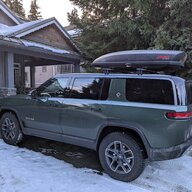
Think about what your vehicle will be parked on while charging. I share a narrow driveway with a neighbor. In order to leave some space for them to get their bikes in and out of their garage while I'm occupying the driveway to charge, I placed paver blocks in the little planting strip between my house and the driveway. I park my Rivian right close to the house and the right wheels are on those blocks. They are sinking! These EV trucks are HEAVY - 8000 lbs for the Rivian.

I have 100 Amp service. I - for some reason - thought it was a good idea to install a natural gas hot water heater and a gas range/oven when I upgraded my furnace from oil-burning to gas. That got rid of a 30A and a 40A breaker out of my 100A panel, giving me room.

Remember - big household appliances like dryers, ranges, and hot water heaters draw power for an hour or so, but an EVSE pulls its full load of amps constantly for several hours. (So don't buy the cheap NEMA 14-50 socket from Amazon, they melt. Get one specifically rated for EV chargers, or hard-wire your charger.) Even though I "technically" had freed up 70A of space in my panel, I downrated my charging circuit to 40A and I just use the 32A portable charger (80% of 40A) that came with my Rivian. It charges my Large Pack battery from 20% to 70% just fine overnight (about 9p to 6a). I mostly drive locally, so I charge once or twice a week.

It's so easy that I replaced my Prius with a Chevy Bolt. It's so crazy to think that I used to have to drive to a special place to put energy in my car instead of that happening at home while I was sleeping. Now if I could just get an overnight automatic car washer installed at my house too...
 
Top